
Is IPTV Legal in the USA? What You Need to Know in 2026
Is IPTV legal in the USA? Yes. IPTV is a technology used to deliver television and video over internet networks, and using IPTV technology is not inherently illegal in the United States. The important legal question is whether a particular provider has the necessary rights or authorization to distribute the content it offers. While IP-based transmission is widely utilized by legitimate media companies and telecommunications providers, the legal status of any individual IPTV service depends on its licensing, the content being accessed, and applicable federal laws. In this 2026 legal guide, we break down U.S. copyright frameworks, clarify the legal distinctions between devices, apps, and content, and provide practical guidance on how to evaluate IPTV providers responsibly.
📌 Key Takeaways
- Technology vs. Service: IPTV is a delivery technology. The legal status of a specific service depends on its content, licensing, and authorization under applicable laws.
- Devices and Players: Fire TV devices, Smart TVs, and IPTV player applications are not themselves proof that the content accessed through them is authorized.
- Commercial Streaming Enforcement: U.S. federal law includes criminal provisions aimed at certain commercial illicit streaming operations that re-transmit copyrighted works for financial gain.
- Price Does Not Determine Legality: A free service isn’t automatically legal, and an expensive service isn’t automatically legal. Transparency, terms, and authorization are what matter.
IPTV is a technology for delivering television over internet networks and is not inherently illegal in the USA. However, not every service using IPTV technology is necessarily authorized to distribute every channel, movie, or sports event it offers. The relevant questions concern the provider, the content, and whether the provider has the necessary rights or authorization under applicable copyright laws.
What Is IPTV?
To evaluate legal questions around modern streaming, it is helpful to start with a clear definition. IPTV stands for Internet Protocol Television. Rather than representing a single product or commercial service, IPTV is a technological method of delivering television programming, live channels, and video-on-demand content over internet networks using IP data standards.
Unlike traditional distribution systems that rely on coaxial cables or satellite dishes, IPTV transmits video data packets across standard broadband infrastructure. This method allows viewers to stream live television signals or access recorded media on connected devices. IP-based television delivery is used by legitimate telecommunications companies and major streaming services across North America. To learn more about how internet television operates, explore our beginner’s guide to IPTV.
Because IPTV is simply a transmission protocol, the technology itself does not determine whether a particular stream is authorized. Asking about IPTV legality USA requires examining the specific provider offering the service and the content being distributed, rather than the underlying network format.
IPTV Technology vs. IPTV Providers
A frequent source of confusion when discussing is IPTV legal is failing to distinguish between the underlying technology, the service provider, and the playback application. Understanding these three distinct parts of the streaming ecosystem clarifies how legal frameworks apply:
The internet protocol method used to route video data across networks.
The service entity aggregating channel feeds, VOD libraries, and subscriptions.
The software application installed on a device to decode and play streams.
A helpful analogy is a standard internet web browser. A web browser is neutral software that uses HTTP standards to load web pages. People use web browsers daily to read news, manage bank accounts, and stream video lawfully. If an individual uses a browser to access an unauthorized file-sharing portal, the browser software itself remains legal; responsibility lies with the entity hosting unauthorized content.
The same logic applies to IPTV streaming legal concepts. IPTV technology is a neutral delivery mechanism. An IPTV provider USA is the commercial service that supplies content to consumers. If a provider holds appropriate carriage agreements, broadcast licenses, or permission from rights holders, its service operates within the law. If a provider re-transmits television broadcasts without authorization, that specific distribution can raise serious legal issues under copyright statutes. The legal questions therefore concern the content and service being accessed, rather than the mere existence of the player application.
What Makes an IPTV Service Legal?
Whether an IPTV service operates lawfully under U.S. law generally depends on whether the provider holds valid broadcast licensing, re-transmission consent, or authorization from copyright holders. U.S. copyright and communications laws can impose requirements on the unauthorized retransmission or distribution of television programming and other copyrighted content.
When evaluating a legal IPTV provider, there are several practical operational signals consumers can investigate when evaluating a provider:
- Verifiable Corporate Identity: Transparent operators typically provide registered corporate business names, physical business addresses, and clear contact channels in their documentation.
- Clear Terms of Service & Policies: Published Terms of Service, End User License Agreements (EULA), and Privacy Policies explain how user accounts and data are handled under consumer standards.
- Standard Payment Options: Established merchant processing options (such as credit cards or official app store billing) provide standard billing transparency and buyer protections.
- Content & Licensing Information: Legitimate services are open about their content distribution rights, channel offerings, or corporate affiliations where applicable.
- Accessible Customer Support: Reliable companies operate accessible support channels, such as email help desks, ticketing portals, or live customer service.
It is crucial to understand that these factors are signals to evaluate, NOT absolute proof of legality. A well-designed website, standard payment processor, or physical office address does not independently prove that a service possesses rights to every channel in its lineup. Consumers may not be able to independently verify every licensing agreement, but transparency about the service and its content can still be a useful factor when comparing providers.
Is Streaming Copyrighted Content Without Permission Legal?
Understanding IPTV copyright law requires examining general U.S. intellectual property standards. Under 17 U.S.C. § 106 of the U.S. Copyright Act (maintained by the U.S. Copyright Office), copyright owners hold exclusive rights to authorize the public performance, distribution, and reproduction of their protected works. Distributing or re-transmitting copyrighted television broadcasts, movies, or live sporting events without authorization from the copyright holder can constitute IPTV copyright infringement under civil law.
U.S. copyright law establishes legal distinctions between unauthorized commercial distribution and individual viewing activity. Civil enforcement actions generally target unauthorized distributors and commercial services that re-transmit copyrighted material without licenses, subjecting such operators to statutory damages and court injunctions.
The Protecting Lawful Streaming Act of 2020 (18 U.S.C. § 2319N) created a federal felony offense aimed at certain commercial illicit streaming operations. The law focuses on unauthorized streaming services operated for commercial advantage or private financial gain. According to official statements from the U.S. Department of Justice (DOJ), the statute targets commercial streaming piracy rather than ordinary users of the services.
Federal law enforcement agencies—including the Department of Justice, Federal Bureau of Investigation, and Homeland Security Investigations—alongside coalition groups like the Alliance for Creativity and Entertainment (ACE), direct enforcement efforts primarily toward commercial operators, domain seizures, and illicit streaming networks. While legal outcomes for individual viewers depend on specific circumstances, utilizing unauthorized services presents operational risks, including sudden service shutdowns, security vulnerabilities, and potential terms-of-service violations with Internet Service Providers.
Are Free IPTV Services Legal?
A common question among cord-cutters is whether free IPTV legal options exist, or if free content is inherently suspect. The reality is that subscription price alone does not determine legality. Free services can operate lawfully, just as paid services can raise legal questions.
Millions of U.S. consumers stream legal free programming through Free Ad-Supported Streaming TV (FAST) platforms, such as Pluto TV, Tubi, Xumo Play, The Roku Channel, and Plex. These platforms license television shows, movies, and linear channels directly from content owners and monetize viewership through video advertising. Additionally, public broadcasting feeds, local government channels, and educational broadcasts are routinely made available over open internet feeds. However, services that offer premium pay-TV channels or first-run movies for free without advertising or authorization carry significant warning signs of unauthorized distribution.
Does an IPTV Free Trial Mean the Service Is Legal?
When researching providers, consumers often ask if an IPTV free trial proves that a service is legitimate. In short, a free trial is a marketing and technical evaluation feature—it allows a user to test stream stability, channel buffering, and app interface compatibility for a short period (such as 24 hours).
Offering a trial does not independently prove that a provider has authorization to distribute its content. Both authorized streaming services and unauthorized operators utilize evaluation periods to demonstrate their technical infrastructure. While testing a service helps verify line performance and EPG reliability, users should evaluate corporate transparency alongside technical performance. To learn how to test streaming performance effectively, review our guide on how to test IPTV with a free trial.
Are IPTV Apps and Players Legal?
To view streams on Smart TVs or mobile hardware, consumers use application software known as IPTV players (such as TiviMate, IPTV Smarters Pro, IBO Player, or VLC). An IPTV player is not inherently unlawful simply because it can play IPTV streams.
Under U.S. legal principles, an IPTV player application is a software tool. When downloaded from an application store, it functions as a blank shell containing no pre-loaded channels or video streams. It relies on the user to provide media input, such as an M3U playlist link or server credentials. Media player applications have substantial lawful uses, including viewing home video collections, open-access public streams, or personal security camera feeds. Legal questions focus on the content and service being accessed, rather than the existence of the player application software itself. For a review of top media applications, see our guide to IPTV players.
Is IPTV Legal on Firestick, Smart TVs, and Android TV?
Streaming media hardware—including Amazon Fire TV devices, Samsung Smart TVs, LG webOS TVs, Android TV boxes, Apple TV, and Roku players—are standard consumer electronics. Using IPTV on a Fire TV device, Smart TV, Android TV device, phone, tablet, or computer is not inherently illegal. The relevant question is the service and content being accessed.
✓ Standard Hardware & Device Usage
- Streaming devices and Smart TVs are standard consumer electronics widely sold by retail outlets.
- Downloading media applications onto streaming devices is standard hardware functionality.
- Open operating systems allow users to install media applications to view personal or online streams.
✕ Caution Required With Pre-Configured Devices
- Purchasing pre-configured “loaded” streaming sticks from unverified sellers introduces security and legal risks.
- Pre-loaded devices sold with unauthorized stream links bypass standard app store security vetting.
- Modified hardware can expose users to malware, security vulnerabilities, or privacy breaches.
Hardware streaming tools are neutral. However, consumers should be cautious of third-party vendors selling pre-loaded “jailbroken” or fully configured TV sticks online. These devices often bundle unauthorized streaming tools that pose security risks. It is safer to purchase factory-clean hardware and configure apps manually using our IPTV installation guide.
What About IPTV Sports Streaming?
Live sports broadcasts represent some of the most valuable intellectual property in broadcasting. Professional sports leagues (NFL, NBA, MLB, NHL, Premier League) and combat sports promoters license exclusive regional and national distribution rights to specific network partners.
Because live sports rights carry high commercial value, unauthorized retransmission of sports feeds attracts significant legal enforcement from rights holders and anti-piracy organizations like the Alliance for Creativity and Entertainment (ACE). For viewers seeking to stream sporting events over IP networks, choosing authorized outlets ensures reliable high-definition feeds without unexpected stream blackouts. If you’re comparing IPTV with a mainstream live-TV platform, our guide to IPTV vs. YouTube TV looks at the differences between the two approaches. For more on sports streaming options, consult our guide to watch live sports without cable.
What About Movies and TV Shows on IPTV?
In addition to live channels, many IPTV services offer Video-on-Demand (VOD) libraries containing movies and television series. Like live broadcasts, recorded films and TV shows are copyrighted works protected under U.S. law.
Film studios license content through structured distribution windows. Authorized services obtain proper distribution rights or leverage licensed syndication catalogs to offer VOD titles lawfully. Unusually broad catalogs or claims that appear inconsistent with normal licensing arrangements may be a reason for consumers to investigate further. For guidance on setting up on-demand viewing, read our guide on how to watch movies and TV shows on IPTV.
How Can You Check Whether an IPTV Provider Is Legitimate?
Because there is no central government clearinghouse for internet streaming services, consumers must evaluate providers independently. Use this 8-point checklist to evaluate a provider’s operational transparency:
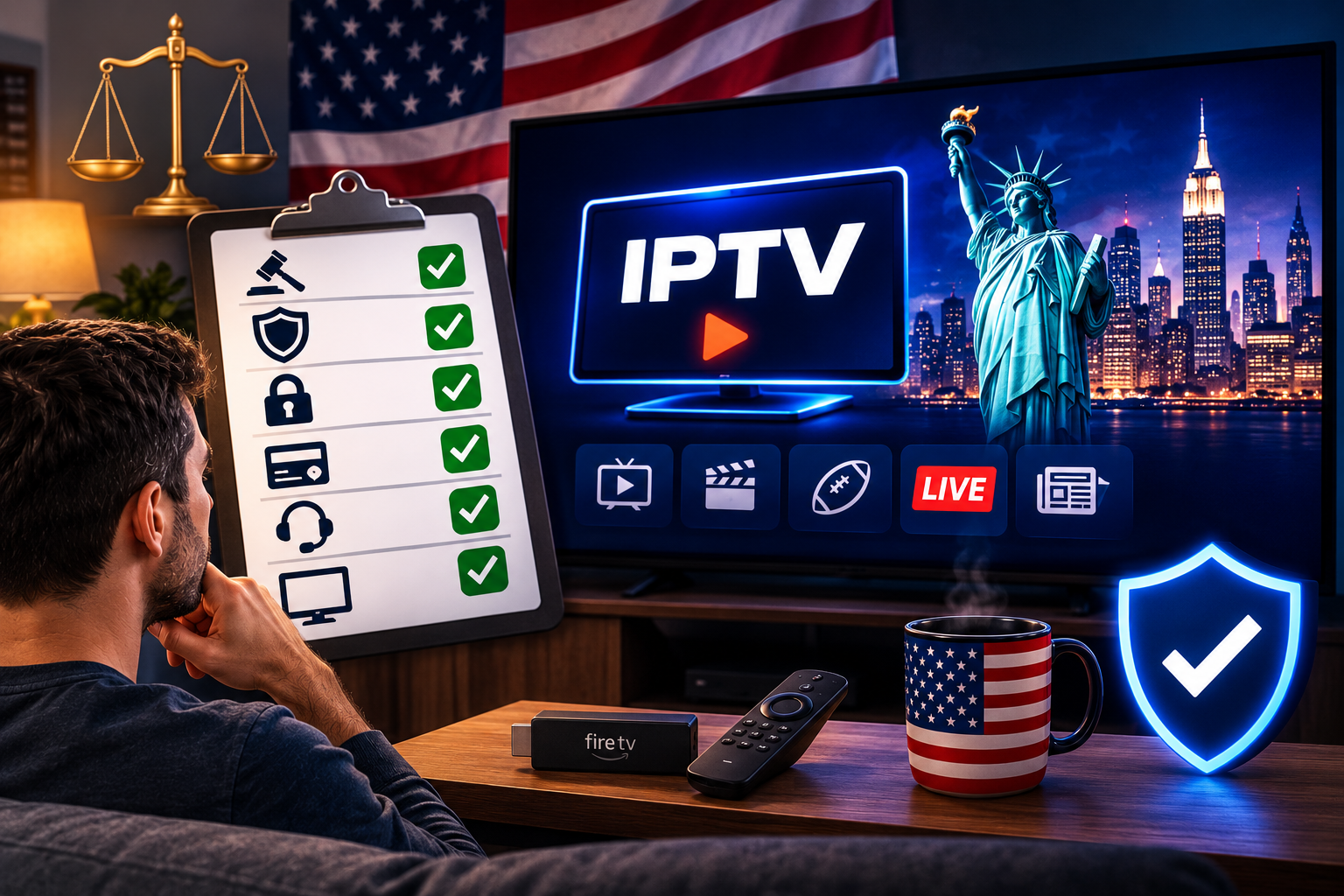
- Check Corporate Information: Look for published corporate entity details, physical business addresses, and official contact information on the provider’s website.
- Read Terms of Service & Policies: Review published Terms of Service, Privacy Policies, and user agreements for clear billing and account handling terms.
- Understand Pricing & Renewal Terms: Check for clear, predictable subscription pricing models and transparent renewal conditions.
- Check Customer Support Channels: Test customer service responsiveness via official help desks, ticketing portals, or email support.
- Be Cautious of Unrealistic Claims: Be skeptical of claims offering “100,000 Channels + All PPV Events Free Forever.” Quality network infrastructure requires operational investment.
- Avoid Suspicious Software Downloads: Use standard M3U links, Xtream Codes credentials, or official app downloads rather than unverified executable files from untrusted sources.
- Investigate Content & Authorization Disclosures: Look for transparency regarding content carriage, channel lineups, and syndication partners where available.
- Test Performance via Evaluation Options: Utilize short evaluation periods or trials to test stream latency, channel zapping speed, and EPG reliability on your home Wi-Fi.
Keep in mind that none of these individual factors independently proves legality. They are practical markers to assist in consumer evaluation. For a broader comparison of service features and provider evaluation, review how to choose an IPTV subscription.
What About IPTV Pricing?
Subscription costs are frequently discussed in relation to IPTV regulations USA. However, price alone does not determine legality. A low price does not automatically mean a service is illegal, nor does a high price prove that a service is fully licensed.
Legitimate Free Ad-Supported Streaming TV (FAST) platforms charge $0 per month while operating legally via advertising. Conversely, unauthorized operators sometimes set higher prices to appear legitimate. What matters is content authorization, corporate transparency, and clear business terms. For an overview of subscription structures and package options, see our guide to IPTV pricing.
IPTV Legal vs. Potentially Unauthorized
To help compare provider indicators, review this reference table outlining operational factors:
| Factor | More Transparent Service | Potential Warning Sign |
|---|---|---|
| Company Information | Discloses legal corporate entity, physical business address, and contact details. | Completely anonymous web presence with no verifiable corporate information. |
| Pricing Model | Clear subscription tiers with transparent billing cycles and refund policies. | Unrealistically cheap “lifetime” offers or ambiguous billing conditions. |
| Terms & Disclosures | Publishes detailed Terms of Service, EULA, and privacy disclosures. | No published Terms of Service or user policies available. |
| Customer Support | Operates official support ticketing, email, or live customer service. | No formal customer support channels provided. |
| Payment Options | Supports standard credit cards, merchant gateways, or official app store billing. | Requires anonymous, non-refundable payment methods as the sole option. |
| Application Sourcing | Provides standard credentials for neutral players or official app store links. | Requires downloading unverified executable files from suspicious third-party links. |
| Marketing Claims | Focuses on stream performance, EPG support, resolution, and device compatibility. | Claims unlimited unauthorized access to all worldwide pay-per-view events for free. |
Common Misconceptions About IPTV Legality
Given how fast streaming technology evolves, several common misconceptions persist regarding IPTV laws USA:
Myth 1: “IPTV technology itself is illegal.”
Fact: IPTV is a method of delivering television and video programming over IP networks. The technology itself is neutral; legality depends on content authorization and service licensing.
Myth 2: “If an app is in an official app store, every stream inside it is legal.”
Fact: App stores host neutral media player applications (like VLC or TiviMate). App-store availability does not establish authorization for third-party stream URLs loaded into the app by a user.
Myth 3: “If I pay for IPTV, it must be legal.”
Fact: Paying a subscription fee does not prove that a provider holds content licensing rights. Payment status alone does not determine legal authorization.
Myth 4: “If IPTV is free, it must be illegal.”
Fact: Some free streaming services are authorized, including legitimate FAST platforms monetized through digital advertising.
Myth 5: “Using a Firestick makes IPTV illegal.”
Fact: An Amazon Fire TV device is standard streaming hardware. The device itself does not determine the legality of the service or content being accessed.
What Should You Check Before Subscribing?
Before subscribing to an IPTV service, consider these practical evaluation questions:
- Who operates the service, and is corporate background information available?
- Are the Terms of Service, Privacy Policy, and cancellation policies clearly stated?
- Are pricing tiers and renewal terms transparent?
- Is customer support accessible if technical issues arise?
- Does the service work smoothly on your preferred hardware devices?
- Is an evaluation period or trial available to test stream performance?
- Does the Electronic Program Guide (EPG) load accurately during testing?
- Does the content offering align logically with the provider’s scope?
- Are application downloads coming from trusted sources?
- Are marketing claims focused on service performance rather than unrealistic promises?
Considering an IPTV Subscription?
Once you’ve evaluated a provider’s transparency, terms, content offering, and device compatibility, you can review the available subscription options before deciding whether the service is right for you.
Frequently Asked Questions (FAQs)
1. Is IPTV legal in the USA?
Yes. IPTV is a technology used to deliver television over internet networks, and using IPTV technology is not inherently illegal in the United States. The legal question concerns whether a particular provider has the necessary rights or authorization to distribute the content it offers.
2. Is IPTV illegal?
IPTV technology itself is not illegal. However, an IPTV service can raise legal issues if it re-transmits or sells access to copyrighted television channels, live sports, or movie libraries without appropriate permissions or distribution licenses.
3. Is IPTV legal on Firestick?
Using IPTV on a Fire TV device is not inherently illegal. The Firestick is a standard media playback device. The relevant question is whether the service and content being accessed are authorized.
4. Is IPTV legal on Smart TVs?
Using IPTV applications on Smart TVs (such as Samsung, LG, or Android TV) is not inherently illegal. Legality depends on the service and content accessed through the app, not the television hardware.
5. Is free IPTV legal?
Free IPTV can be authorized. Legitimate Free Ad-Supported Streaming TV (FAST) services (like Pluto TV or Tubi) operate legally through advertising revenue. However, free services offering premium pay-TV content without ads or licensing carry warning signs of unauthorized distribution.
6. Are IPTV free trials legal?
A free trial is simply a way to test a service. The existence of a trial does not determine whether the provider has authorization to distribute its content.
7. Are IPTV apps legal?
An IPTV player is not inherently unlawful simply because it can play IPTV streams. Standalone IPTV players (like TiviMate or VLC) are neutral software tools containing no content. Legality depends on the streams loaded by the user.
8. Can I watch sports through IPTV legally?
Yes. Sports can be streamed legally through IPTV when the service has the appropriate rights or authorization to distribute the event.
9. How can I tell if an IPTV provider is legitimate?
Evaluate provider transparency, corporate identity disclosures, published Terms of Service, standard payment options, accessible customer support, and clear operational practices.
10. Does paying for IPTV make it legal?
No, paying a fee alone does not establish legality. Unauthorized operators may charge monthly fees to offset server hosting costs. Legality depends on content authorization, not payment status.
Final Verdict
Navigating internet television in 2026 comes down to a clear understanding of digital technology and copyright principles. The core takeaway remains straightforward: IPTV is a technology for delivering television and video over internet networks. The technology itself is not inherently illegal. The legal question is whether a particular service is authorized to distribute the content it offers and how applicable law applies to the specific circumstances.
Consumers should distinguish between neutral transmission technology, hardware playback tools, and individual service providers. Rather than assuming the term “IPTV” implies illegality or automatic approval, viewers should evaluate providers based on business transparency, published terms of service, customer support accessibility, and fair operational practices. By taking an informed approach to evaluating providers, U.S. viewers can make confident decisions about their home entertainment setup.